


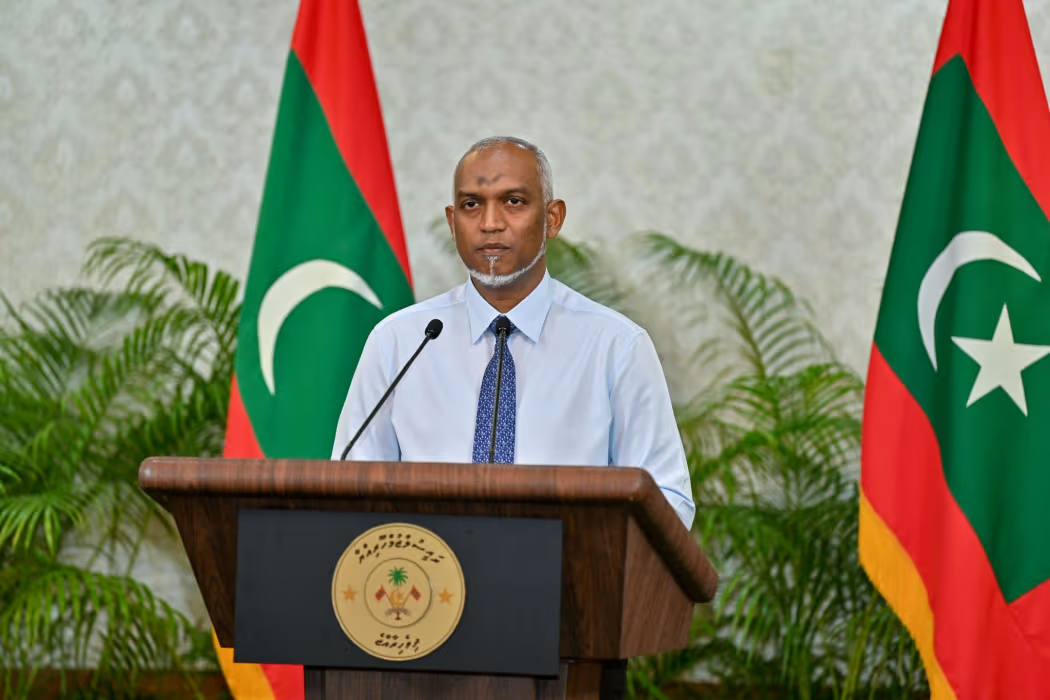
A translated report circulated this week has blurred an important distinction in President Dr Mohamed Muizzu’s remarks on the widening Middle East war. The issue is not whether the President’s language was sharply critical of Israel, or whether he spoke in terms that appeared supportive of Iranian retaliation against those directly attacking Iran. It is that those remarks were then stretched into suggesting that the Maldives was endorsing attacks on Gulf Arab countries themselves. The government’s own published record shows a narrower and more consistent position, opposition to the continuing attacks on Iran, rejection of military spillover into neighbouring states, and insistence that Gulf countries must not bear the human and infrastructural cost of a wider regional war.
That distinction is critical because the Maldives has not formally positioned itself as openly siding against either Israel or the United States as states. Rather, its official line has been to call for an end to the aggression, reject further escalation, and maintain that neighbouring Gulf countries, despite hosting U.S. military assets and bases under their own sovereign arrangements, should not be turned into battlefields. The central concern running through the government’s statements has been that Muslim populations, civilian infrastructure and the sovereignty of Arab states must not become collateral damage in a conflict that is already destabilising the wider region.
The clearest baseline appears in the Maldives government’s 28 February statement on recent developments in the Middle East. In that statement, the government said the Maldives “denounces attacks from all sides”, called for immediate de-escalation, and stressed that all parties must act in full respect of international law and the United Nations Charter. Crucially, it reaffirmed that the sovereignty and territorial integrity of all states must be respected. This establishes the government’s consistent position against any widening of the conflict into neighbouring territories.
That position was further reinforced in the 10 March statement condemning attacks by Israel and the United States against Iran, and attacks by Iran against states in the Gulf region. The Maldives explicitly condemned the strikes against Iran, while also strongly condemning Iranian attacks affecting Gulf countries including Saudi Arabia, the United Arab Emirates, Qatar, Kuwait and Bahrain. The same statement called for an immediate ceasefire by all parties. Taken together, these statements show a consistent dual position, opposing both the initial aggression against Iran and any retaliatory spillover that harms neighbouring Gulf states.
Within this context, the President’s recent remarks should be understood more precisely. As reflected in the translated account, his language was clearly critical of Israel and framed in a way that could be interpreted as supportive of Iranian retaliation against those directly engaged in the war. However, this does not equate to an endorsement of harm against GCC states themselves. The consistent thread in his remarks is that any escalation must not result in civilian casualties or infrastructure destruction in neighbouring Arab countries, which would ultimately bear the cost of a wider conflict.
The President also clarified the Maldives’ operational stance in terms that align with neutrality rather than defiance. Addressing the visit of U.S. Special Envoy Sergio Gor, he stated that there was no need for discussions with the United States on matters relating to the war, and that the Maldives would not provide any form of cooperation involving the use of its territory for the conflict. This position is not framed as opposition to any one state, but as a clear assertion that the Maldives will not be drawn into military involvement.
The President’s Office record further supports this balanced posture. In a 2 March statement, President Dr Muizzu affirmed that the Maldives would stand alongside Arab and Islamic nations as one unified bloc amid rising tensions. The same statement noted expressions of solidarity with the leadership of the United Arab Emirates and intentions to extend similar support to Saudi Arabia, Qatar, Bahrain and Oman. This reflects a position grounded in regional solidarity rather than hostility.
Recent reporting by Atoll Times also indicates that President Dr Muizzu made clear that no part of Maldivian territory would be made available for military operations linked to the conflict. This reinforces a consistent non-aligned posture, where the Maldives maintains political positions on the conflict while avoiding operational or military entanglement.
None of this suggests that the President’s rhetoric was neutral in tone. His remarks were pointed, particularly in relation to Israel, and may be interpreted as politically supportive of resistance against ongoing attacks on Iran. However, the broader claim that the Maldives is endorsing attacks on Gulf countries themselves is not supported by the government’s official statements or actions. On the contrary, the record consistently emphasises de-escalation, ceasefire, respect for sovereignty, and the protection of neighbouring Gulf states from the consequences of escalation.
The distinction is therefore substantive. The Maldives’ position has been to oppose the continuation of attacks on Iran, to reject escalation that spreads conflict across the region, and to ensure that neighbouring GCC countries are not drawn into direct harm despite hosting foreign military infrastructure. It has also maintained a clear stance that Maldivian territory will not be used to support the conflict.
Any fair reading of President Dr Mohamed Muizzu’s remarks must therefore separate strong political rhetoric about the war from any suggestion of endorsing harm to Gulf Arab states. The official record shows a government attempting to maintain a careful and consistent position, opposing aggression, avoiding military involvement, and safeguarding the principle that the war must not spill over into neighbouring sovereign states.