


Advertisementspot_img

Malé warehouse fire exposes regulatory gaps and sharpens urgency of port relocation

A fire at a chemical warehouse in the capital has again raised the question of why hazardous storage remains embedded inside one of the world’s most densely populated urban islands.

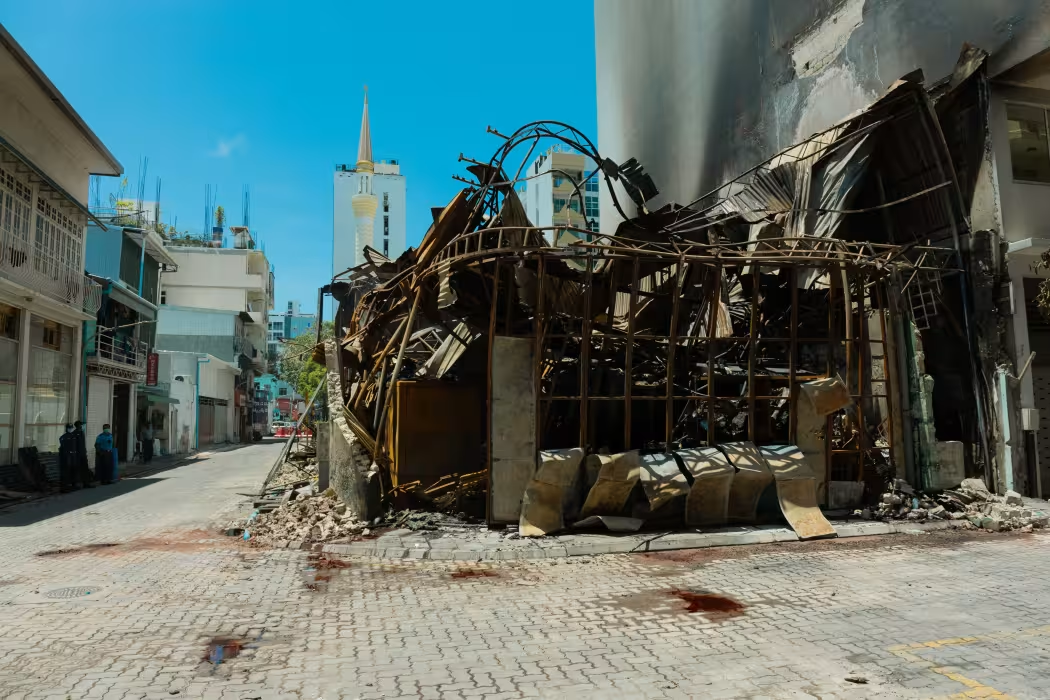
A fire at a Prime Fertiliser warehouse in Maafannu has again exposed how dangerous-chemical storage remains entangled with daily life in the capital, despite years of policy promises and regulatory tightening after earlier disasters. According to reporting by The Edition, the facility stored fertilisers, pesticides and other agricultural supplies, and company representatives said the current framework has allowed such storage in Malé for retail purposes while failing to clearly define how much material may be kept at one site.

The consequences were not confined to the warehouse itself. In follow-up reporting, The Edition said toxic smoke spread across Malé, the Health Protection Agency urged residents to take precautions, and one woman was taken to hospital after her condition worsened due to smoke inhalation. A subsequent report said the National Disaster Management Authority registered 454 people from 15 houses at an evacuation centre overnight, while 77 people from 10 homes were given temporary shelter and seven people were taken to hospital due to the smoke. This is precisely why hazardous storage in dense residential and mixed-use neighbourhoods cannot be treated as a routine commercial convenience. When such incidents occur, the loss to lives, health and property can be severe, and in the worst cases irrecoverable.

The wider policy problem is now hard to ignore. For dangerous cargo, including cargo that may fall under the International Maritime Organization’s International Maritime Dangerous Goods Code, the current model of storing and distributing hazardous materials within a tightly packed urban population centre is no longer tenable. The IMDG Code exists because dangerous goods require strict controls over packing, segregation, stowage and fire precautions. A city like Malé, where residences, retail, traffic, public offices and storage activities exist side by side, is structurally ill-suited to absorb repeated warehousing risk of that kind.

This is also not a new warning. After the 2019 Henveiru warehouse fire, the President’s Office said then-President Ibrahim Mohamed Solih instructed authorities to immediately begin relocating chemical storages to a safe and isolated location away from residential areas. That same statement said officials had identified 126 chemical storages in Malé at the time and acknowledged the danger of storing hazardous flammable chemicals in densely populated areas. Yet the latest fire shows that the regulatory and enforcement problem was never fully resolved.

The latest blaze therefore does more than expose a flaw in rules or compliance. It underscores the strategic necessity of relocating the port, warehouses and the adjoining logistics ecosystem away from urban population centres and into properly planned industrial zones. In practical terms, that means accelerating the phased migration to Thilafushi, where cargo handling, storage, emergency response, segregation of incompatible goods and regulatory monitoring can be designed into the operating environment from the outset. It also means using the broader Greater Malé industrial build-out, including areas linked to Gulhifalhu, to absorb storage and distribution functions that should never have remained embedded in the capital’s neighbourhood fabric.

On the relocation pledge itself, President Mohamed Muizzu did publicly state in his 2026 Presidential Address that the relocation of the commercial harbour to Thilafushi would be completed and opened by 11 November 2027. He said the move would reduce unloading times for cargo vessels from as much as seven days to within 48 hours, and argued that it would address the public difficulties caused by the need to store goods in Malé. That commitment matters far beyond cargo efficiency. It is also a public-safety deadline.

If that date is to mean anything in practical terms, port migration planning cannot be limited to quay walls, cranes and vessel turnaround. It must include an orderly, enforceable transition plan for businesses that import, use, store or distribute IMDG-class and other hazardous cargo. Those operators need sufficient lead time, designated plots, compliant warehouse specifications, fire-suppression systems, environmental safeguards, licensing conditions and inspection protocols well ahead of the final move. Businesses dealing in such materials cannot be expected to shift overnight, but neither can the state continue to tolerate indefinite delay.

The lesson from this week’s fire is plain. The storage and distribution of dangerous cargo in Malé, simply because commercial demand has historically required it, is no longer a defensible arrangement. An immediate solution is warranted. The Maldives now needs a unified transition programme that links chemical regulation, port relocation, warehouse zoning, emergency preparedness and business migration into a single national logistics safety effort. Anything less would leave Malé exposed to the next preventable warehouse emergency.

- Advertisement -spot_img

A fire at a Prime Fertiliser warehouse in Maafannu has again exposed how dangerous-chemical storage remains entangled with daily life in the capital, despite years of policy promises and regulatory tightening after earlier disasters. According to reporting by The Edition, the facility stored fertilisers, pesticides and other agricultural supplies, and company representatives said the current framework has allowed such storage in Malé for retail purposes while failing to clearly define how much material may be kept at one site.

The consequences were not confined to the warehouse itself. In follow-up reporting, The Edition said toxic smoke spread across Malé, the Health Protection Agency urged residents to take precautions, and one woman was taken to hospital after her condition worsened due to smoke inhalation. A subsequent report said the National Disaster Management Authority registered 454 people from 15 houses at an evacuation centre overnight, while 77 people from 10 homes were given temporary shelter and seven people were taken to hospital due to the smoke. This is precisely why hazardous storage in dense residential and mixed-use neighbourhoods cannot be treated as a routine commercial convenience. When such incidents occur, the loss to lives, health and property can be severe, and in the worst cases irrecoverable.

The wider policy problem is now hard to ignore. For dangerous cargo, including cargo that may fall under the International Maritime Organization’s International Maritime Dangerous Goods Code, the current model of storing and distributing hazardous materials within a tightly packed urban population centre is no longer tenable. The IMDG Code exists because dangerous goods require strict controls over packing, segregation, stowage and fire precautions. A city like Malé, where residences, retail, traffic, public offices and storage activities exist side by side, is structurally ill-suited to absorb repeated warehousing risk of that kind.

This is also not a new warning. After the 2019 Henveiru warehouse fire, the President’s Office said then-President Ibrahim Mohamed Solih instructed authorities to immediately begin relocating chemical storages to a safe and isolated location away from residential areas. That same statement said officials had identified 126 chemical storages in Malé at the time and acknowledged the danger of storing hazardous flammable chemicals in densely populated areas. Yet the latest fire shows that the regulatory and enforcement problem was never fully resolved.

The latest blaze therefore does more than expose a flaw in rules or compliance. It underscores the strategic necessity of relocating the port, warehouses and the adjoining logistics ecosystem away from urban population centres and into properly planned industrial zones. In practical terms, that means accelerating the phased migration to Thilafushi, where cargo handling, storage, emergency response, segregation of incompatible goods and regulatory monitoring can be designed into the operating environment from the outset. It also means using the broader Greater Malé industrial build-out, including areas linked to Gulhifalhu, to absorb storage and distribution functions that should never have remained embedded in the capital’s neighbourhood fabric.

On the relocation pledge itself, President Mohamed Muizzu did publicly state in his 2026 Presidential Address that the relocation of the commercial harbour to Thilafushi would be completed and opened by 11 November 2027. He said the move would reduce unloading times for cargo vessels from as much as seven days to within 48 hours, and argued that it would address the public difficulties caused by the need to store goods in Malé. That commitment matters far beyond cargo efficiency. It is also a public-safety deadline.

If that date is to mean anything in practical terms, port migration planning cannot be limited to quay walls, cranes and vessel turnaround. It must include an orderly, enforceable transition plan for businesses that import, use, store or distribute IMDG-class and other hazardous cargo. Those operators need sufficient lead time, designated plots, compliant warehouse specifications, fire-suppression systems, environmental safeguards, licensing conditions and inspection protocols well ahead of the final move. Businesses dealing in such materials cannot be expected to shift overnight, but neither can the state continue to tolerate indefinite delay.

The lesson from this week’s fire is plain. The storage and distribution of dangerous cargo in Malé, simply because commercial demand has historically required it, is no longer a defensible arrangement. An immediate solution is warranted. The Maldives now needs a unified transition programme that links chemical regulation, port relocation, warehouse zoning, emergency preparedness and business migration into a single national logistics safety effort. Anything less would leave Malé exposed to the next preventable warehouse emergency.

Advertisementspot_img

Related News