


Advertisementspot_img

India Gets Limited Hormuz Passage.

Limited passage, wider danger: India’s LPG relief does little to ease mounting fuel-security risks across the Indian Ocean

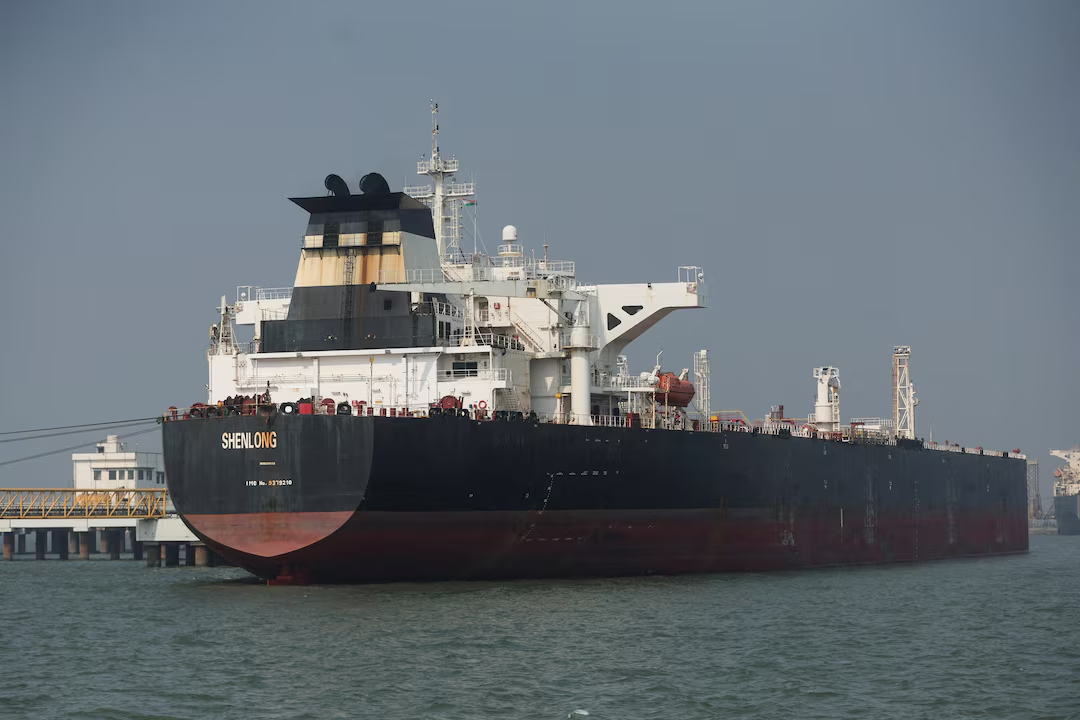
India said on Saturday that two Indian-flagged tankers carrying liquefied petroleum gas, LPG, crossed the Strait of Hormuz safely early in the morning and are now on their way to India’s western ports, according to Reuters reporting from New Delhi. The report said the vessels, chartered by Indian Oil Corp, were carrying more than 92,000 metric tons of LPG combined. It also said New Delhi is still seeking safe passage for 22 Indian vessels stranded west of Hormuz, showing that this is only a partial opening, not a full return to normal shipping.

The development matters because the Strait of Hormuz remains one of the world’s most important energy chokepoints. The U.S. Energy Information Administration says oil flows through the strait averaged 20 million barrels a day in 2024, equal to about 20 percent of global petroleum liquids consumption. In a separate update, the EIA also said that about 20 percent of global LNG trade moved through Hormuz in 2024. That means disruption in the strait does not only affect Gulf producers, it quickly becomes an Asian and global energy-security problem.

India’s policy response shows how severe the pressure has become. Reuters reported that New Delhi has already used emergency measures to protect household supply, including directing refiners to maximise LPG production and cutting supply to industry. On Saturday, India’s petroleum ministry also moved to stop households with piped natural gas, PNG, connections from retaining, obtaining or refilling domestic LPG cylinders, under an amended supply order aimed at preserving available LPG stocks. That comes as India tries to avoid shortages for its hundreds of millions of household LPG users. See Reuters on India’s fuel response.

The wider conflict is still moving in a dangerous direction. Reuters reported on Saturday that U.S. forces struck more than 90 Iranian military targets on Kharg Island, while saying the island’s oil infrastructure was preserved. Kharg is especially sensitive because, as another Reuters analysis on Kharg Island noted, it handles roughly 90 percent of Iran’s crude exports. That means the market is not only watching ship movements in Hormuz, but also whether the conflict begins directly damaging major export infrastructure.

Analysts are increasingly warning that the economic impact will depend on how long the disruption lasts. Reuters reported on Friday that Barclays raised its 2026 Brent forecast to $85 a barrel and said oil could move to $100 if it takes four to six weeks for Hormuz traffic to normalise. The EIA’s latest short-term outlook also says the main upside risk to oil prices is an extended disruption at Hormuz, because most tankers are already avoiding the route due to attack risk and insurance constraints.

For small island developing states, the threat is sharper because the shock is transmitted through imported fuel, electricity costs, freight charges and consumer prices. An IMF working paper published in 2025 found that inflation in SIDS is nearly twice as responsive to international food and fuel price shocks as in non-SIDS economies. That makes prolonged shipping disruption in the Gulf particularly serious for countries with narrow external buffers and high import dependence.
The Maldives fits that risk profile closely. The government’s own Energy Road Map 2024–2033 says fuel price volatility has a major impact on the Maldivian economy, while the World Bank’s latest Maldives Development Update says usable reserves remain below one month of imports. In practical terms, that means a prolonged Gulf supply shock could place pressure on domestic fuel availability, electricity generation, marine transport costs and the general cost of living, even if physical shortages are avoided in the immediate term.

The safe transit of two Indian LPG tankers is therefore a useful signal, but not yet a sign that the crisis is easing. The larger pattern remains one of selective passage, strained diplomacy and rising market anxiety. For Maldives and other import-dependent island economies, the central question is no longer only whether oil and gas can move through Hormuz, but how long the region can absorb higher costs and tighter supply conditions if the conflict keeps escalating.

- Advertisement -spot_img

India said on Saturday that two Indian-flagged tankers carrying liquefied petroleum gas, LPG, crossed the Strait of Hormuz safely early in the morning and are now on their way to India’s western ports, according to Reuters reporting from New Delhi. The report said the vessels, chartered by Indian Oil Corp, were carrying more than 92,000 metric tons of LPG combined. It also said New Delhi is still seeking safe passage for 22 Indian vessels stranded west of Hormuz, showing that this is only a partial opening, not a full return to normal shipping.

The development matters because the Strait of Hormuz remains one of the world’s most important energy chokepoints. The U.S. Energy Information Administration says oil flows through the strait averaged 20 million barrels a day in 2024, equal to about 20 percent of global petroleum liquids consumption. In a separate update, the EIA also said that about 20 percent of global LNG trade moved through Hormuz in 2024. That means disruption in the strait does not only affect Gulf producers, it quickly becomes an Asian and global energy-security problem.

India’s policy response shows how severe the pressure has become. Reuters reported that New Delhi has already used emergency measures to protect household supply, including directing refiners to maximise LPG production and cutting supply to industry. On Saturday, India’s petroleum ministry also moved to stop households with piped natural gas, PNG, connections from retaining, obtaining or refilling domestic LPG cylinders, under an amended supply order aimed at preserving available LPG stocks. That comes as India tries to avoid shortages for its hundreds of millions of household LPG users. See Reuters on India’s fuel response.

The wider conflict is still moving in a dangerous direction. Reuters reported on Saturday that U.S. forces struck more than 90 Iranian military targets on Kharg Island, while saying the island’s oil infrastructure was preserved. Kharg is especially sensitive because, as another Reuters analysis on Kharg Island noted, it handles roughly 90 percent of Iran’s crude exports. That means the market is not only watching ship movements in Hormuz, but also whether the conflict begins directly damaging major export infrastructure.

Analysts are increasingly warning that the economic impact will depend on how long the disruption lasts. Reuters reported on Friday that Barclays raised its 2026 Brent forecast to $85 a barrel and said oil could move to $100 if it takes four to six weeks for Hormuz traffic to normalise. The EIA’s latest short-term outlook also says the main upside risk to oil prices is an extended disruption at Hormuz, because most tankers are already avoiding the route due to attack risk and insurance constraints.

For small island developing states, the threat is sharper because the shock is transmitted through imported fuel, electricity costs, freight charges and consumer prices. An IMF working paper published in 2025 found that inflation in SIDS is nearly twice as responsive to international food and fuel price shocks as in non-SIDS economies. That makes prolonged shipping disruption in the Gulf particularly serious for countries with narrow external buffers and high import dependence.
The Maldives fits that risk profile closely. The government’s own Energy Road Map 2024–2033 says fuel price volatility has a major impact on the Maldivian economy, while the World Bank’s latest Maldives Development Update says usable reserves remain below one month of imports. In practical terms, that means a prolonged Gulf supply shock could place pressure on domestic fuel availability, electricity generation, marine transport costs and the general cost of living, even if physical shortages are avoided in the immediate term.

The safe transit of two Indian LPG tankers is therefore a useful signal, but not yet a sign that the crisis is easing. The larger pattern remains one of selective passage, strained diplomacy and rising market anxiety. For Maldives and other import-dependent island economies, the central question is no longer only whether oil and gas can move through Hormuz, but how long the region can absorb higher costs and tighter supply conditions if the conflict keeps escalating.

Advertisementspot_img

Related News