


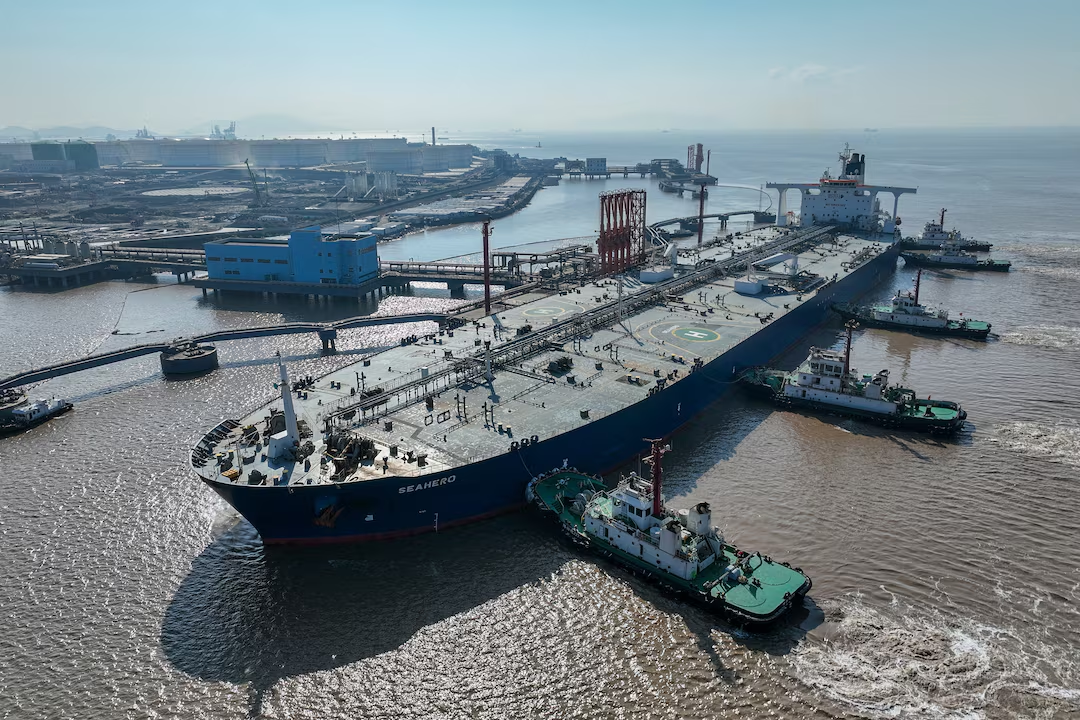
Beijing has cleared half a million tons of refined fuel for export to eight Asia-Pacific countries in May, with the Maldives named on the recipient list — a development that converges meaningfully with the Government’s ongoing fuel security drive.
The Maldives is among eight Asia-Pacific countries cleared to receive Chinese refined fuel shipments in May, according to a Reuters report citing trading sources with direct knowledge of the matter. Beijing has approved 500,000 metric tons of fuel exports for the month to destinations beyond Hong Kong — a near-doubling of forecast April shipments, but still less than half of the roughly 1.6 million tons China averaged monthly to these destinations last year, based on Kpler shiptracking data cited in the report.
Australia, Bangladesh, Cambodia, Laos, Myanmar, New Zealand, and Sri Lanka complete the list of designated recipients alongside the Maldives. The bulk of the allocation — more than half — went to state refining giant Sinopec, with PetroChina cleared for 150,000 tons and CNOOC for 40,000 tons. Diesel and jet fuel are expected to make up at least 40% of the volume.
The May approval marks the first material easing since Beijing clamped down on fuel exports in March to safeguard its domestic market from disruption caused by the closure of the Strait of Hormuz amid the U.S.-Israeli conflict with Iran. The export regime remains tightly controlled: rather than allowing free market allocation, Beijing is designating both volumes and destinations directly, a posture that reflects continued caution over regional supply conditions.
Reuters reports that the easing followed lobbying by Chinese state refiners seeking to capture robust export margins as surging crude costs and lagging domestic pump fuel prices weighed on processing margins. Diesel refining margins in Asia stood at USD 55 a barrel as of 29 April, with jet fuel at USD 62 and gasoline at USD 15.
A Convergence with Maldivian Fuel Security Strategy
For the Maldives, the timing is significant. The Reuters report lands as the Government has been advancing a multi-pronged fuel security agenda under President Dr. Mohamed Muizzu — and Beijing’s decision to name the Maldives on its designated recipient list provides external corroboration of assurances delivered at the recent Cabinet crisis briefing.
Finance Minister Moosa Zameer told reporters at that briefing that fuel prices had stabilised domestically and that “there are no difficulties in securing fuel for the Maldivian market.” The private sector has resumed bulk fuel imports alongside STO, normalising a supply chain that during the period of price instability had relied predominantly on the state trading company.
The Reuters figures also map directly onto two recent sectoral interventions. The Tourism Ministry, working with MACL, reduced Jet A1 fuel prices by 24 cents per litre effective 24 April — a measure flagged by Tourism Minister Mohamed Ameen as a key competitiveness lever for major airlines maintaining service to the Maldives. With jet fuel comprising a meaningful share of the inbound Chinese allocation, that pricing measure may prove sustainable. Similarly, in fisheries, where diesel is the principal operational fuel, the Ministry of Fisheries and Ocean Resources has expanded fuel access from four locations to nine, with sites in Laamu, Thaa, and Meemu coming online this week.
The Strategic Reserve Case Sharpens
If anything, the Reuters report strengthens the rationale for the national strategic fuel storage facility announced by President Dr. Muizzu — a project the Finance Ministry confirms is now in active preparation. The fact that China’s May allocation is less than half of last year’s monthly averages, and that destinations are being directly designated by Beijing rather than allocated by the market, illustrates exactly the kind of structural exposure the reserve is designed to mitigate.
Preparatory work is being led by STO in collaboration with the Ministry of Defence and the Ministry of Finance. STO is currently reviewing two near-Malé lagoons, with technical site studies set to commence next week. A comprehensive plan covering designs, financing, and feasibility is due to be submitted for the President’s review within two weeks. The Finance Minister acknowledged that financing the facility may prove challenging given the ongoing conflict, but maintained that current reserves are inadequate and that increasing strategic capacity has become vital.
The Government has also outlined how the facility could pay for itself: the Finance Minister has indicated that roughly 50% of capacity could be retained for national use, with the remaining 50% rented out to international oil tankers and companies seeking strategic storage in the Indian Ocean. Arrangements with national oil companies from the Middle East — to maintain reserved stock calibrated to Maldivian cashflow — are also under consideration.
Diplomacy Producing Visible Returns
The diplomatic dimension of the Reuters story is harder to overlook. Foreign Minister Iruthisham Adam told the Cabinet briefing that ensuring the continued availability of essential commodities — including fuel at affordable prices — is a principal objective of Maldivian foreign policy under current conditions. The Ministry collects daily updates on the conflict, peace talks, and negotiations, and has formally raised concerns regarding passage through the Strait of Hormuz at the International Maritime Organization.
That maritime advocacy is now directly substantiated by the Reuters reporting, which identifies the Hormuz disruption as the explicit cause of Beijing’s export controls. The Maldives’ inclusion on a designated, discretionary recipient list at this moment — when many regional buyers do not appear — suggests that the Foreign Ministry’s bilateral and multilateral engagement is producing tangible returns even as broader supply remains tight.
What to Watch
The May allocation is a positive signal but does not change the underlying calculus. Beijing’s volumes remain materially below 2025 levels, the Strait of Hormuz situation is unresolved, and the export regime is rationed rather than open. For Maldivian observers, three things will matter in the coming weeks: whether China’s June allocation maintains, expands, or contracts; whether the strategic reserve plan is delivered on its two-week timeline and approved by the President; and whether the regional security situation stabilises or deteriorates further.
Read together with the Government’s domestic measures on prices, fisheries, tourism, and trade flows, the Reuters report fits a coherent picture: a Maldivian economy that is being actively shielded through a combination of infrastructure planning, sectoral support, diversified sourcing, and active diplomacy — and one that, for the moment at least, is being recognised as such by major suppliers in the region.
Reporting based on Reuters, “China approves higher May fuel exports though down from a year ago, sources say,” published 29 April 2026, with additional context from the Government’s recent joint Cabinet briefing on the Middle East crisis response.