



A guesthouse in the Maldives sells a room for the night. It charges GST, because the law requires it. A company in another country sells the same room, to the same guest, for the same night. It pays no tax to the Maldives at all. The room is the same. The only difference is the address of the seller.
A new amendment now before the People’s Majlis aims to close that gap. It brings a rule called the destination principle into the Goods and Services Tax Act. The bill was submitted on 15 August by Kulhudhuffushi North MP Mohamed Dawood, and is now being debated. If passed, it will take effect on 1 October 2026.
A simple rule with a technical name
The destination principle is a simple idea. Tax should be paid where a product or service is used, not where the seller is based.
For the Maldives, the rule works in two directions. If something is used or enjoyed inside the Maldives, it should carry Maldivian GST. It does not matter if the seller is in Male’, in Europe, or anywhere else. If something is exported and used outside the Maldives, it carries no Maldivian GST. The country receiving it will tax it instead. Almost every tax system in the world works this way.
Tax should be paid where a product or service is used, not where the seller is based.
The Maldives has only been applying half of this rule. Today, the tax follows the seller, not the product. A business inside the Maldives must register with MIRA, charge GST, and pay it to the state. A business selling the same thing from abroad does none of this, even when the product is clearly Maldivian.
How the gap works in practice
Think of two purchases.
A shop on Chaandhanee Magu imports a phone case. The shop pays import duty, registers with MIRA, and adds GST at the counter. The customer pays the price plus tax. Now order the same phone case from an overseas online marketplace and have it posted to Male’. It arrives with no Maldivian GST on the sale. Same product, two different final prices. The difference has nothing to do with which business serves its customers better.
The gap is largest in tourism. Tourism GST is now 17 percent, after rising from 16 percent in July 2025. A resort, guesthouse, dive centre or excursion operator inside the Maldives must charge this rate. A foreign booking website or foreign tour operator selling the same stay, the same airport transfer and the same excursion does not. The holiday happens on a Maldivian island either way. But only one seller pays tax to the Maldives.
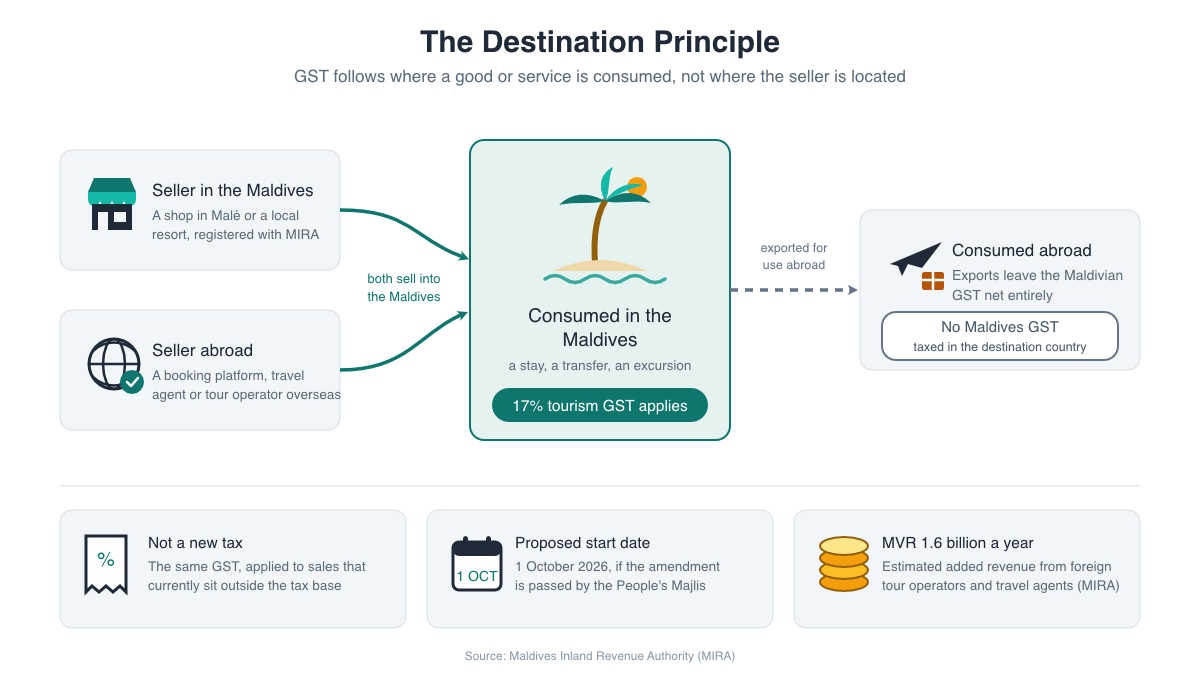
This is not a small leak. Booking platforms, overseas travel agents and foreign tour operators sell a large share of all Maldivian holidays, without any office or staff in the country. The money they add on top of the room price has never been taxed here.
This also puts Maldivian businesses at an unfair disadvantage. A local seller must charge 17 percent. A foreign seller of the same product charges nothing. The local business loses customers not because of its service or its prices, but because of where it is located.
Not a new tax, and not a higher one
This point matters, so it should be said clearly.
The amendment does not create a new tax. It does not raise any tax rate. It takes the GST that already exists and applies it to sales that currently escape it, only because the seller is registered abroad. In simple terms, more sellers will pay the same tax. Nobody will pay a higher rate.
It is also not aimed at ordinary household shopping. The amendment targets tourism products and services sold by foreign companies for use in the Maldives. Essential goods such as basic food items, medicines and utilities are already exempt from GST, and they stay exempt.
For the tourist, the result is the same tax on the same holiday, no matter where it was booked. For the Maldivian business, it means competing on fair terms at last.
What the state expects to earn
MIRA estimates the change will bring in just over MVR 1.6 billion every year.
Foreign tour operators are expected to provide most of it, around MVR 1,309.2 million a year. Overseas travel agents add about MVR 299.3 million more. The total is MVR 1,608.5 million. The cost of setting up the system is small by comparison: MVR 2.8 million once, and about MVR 5.1 million a year to run.

There is a second benefit, and it may matter just as much. Most of this money would arrive in foreign currency, because the foreign sellers earn in dollars and euros. The Maldives has faced a dollar shortage for years. There are not enough dollars in the banking system to meet the demand from importers, businesses and families. This pushes people towards the black market for dollars. A steady new stream of tax income in foreign currency would ease that pressure. It would give the central bank more dollars to supply to businesses and to the public through official channels.
Many countries already do this
This is not an experiment. The destination principle is the accepted international standard, set out in the OECD’s International VAT and GST Guidelines. More than sixty countries across Asia and the small island states already apply some version of it. Worldwide, over one hundred countries now collect tax from foreign sellers in this way.
Australia is the clearest example. Until 2019, foreign websites selling Australian hotel rooms did not have to register for GST. The rule was written in 2005, when online booking was still small. As booking platforms grew, the old rule became a simple price advantage for foreign sellers. Australia removed it from 1 July 2019, saying openly that a hotel room should carry the same tax whether it is booked through a local company or a foreign one.
New Zealand went further in April 2024. It made online platforms responsible for collecting GST on holiday accommodation booked through them.
Singapore did it step by step. It applied GST to digital services from foreign sellers in 2020, and to low value imported goods in 2023. Each time, the stated reason was fair competition between local and foreign businesses. The European Union has taxed digital services this way since 2015, and closed its own low value import loophole in 2021.
The Maldives has also been advised to take this step. In June 2022, the IMF published a technical assistance report called Modernizing the Goods and Services Tax. It found that the structure of the GST Act had barely changed in over ten years, while business models and the digital economy changed around it. The report recommended applying the destination principle clearly, registering foreign sellers, and updating the law for the digital economy.
Will foreign companies actually pay?
Two questions come up, and both have clear answers from other countries.
First, will foreign businesses register and pay? MIRA will provide a simple registration and payment system built for foreign sellers. This is the same model used everywhere else. The large platforms already handle tax in dozens of countries with similar rules. Refusing to comply carries serious costs. International assessments, including the IMF’s, note that being publicly non-compliant with tax rules damages a company’s reputation and its business.
Second, will platforms simply stop selling Maldives holidays? This is very unlikely. The tax is paid by the customer, not by the platform. It changes the price the guest pays, not the profit the platform makes. And no company walks away from a market as valuable as Maldivian tourism over a duty that all of its competitors share equally.
Once the amendment is in force, foreign companies selling tourism products and services used in the Maldives will pay GST at 17 percent. That is the same rate Maldivian businesses have been paying all along.