


Advertisementspot_img

On Track and Gaining: The Renewable Pledge Takes Shape

The Government of Maldives has switched on solar hybrid power systems across 25 islands in Raa and Baa atolls, a step that officials say turns a national climate promise into measurable progress. The systems were formally inaugurated at a ceremony held on the island of Kinolhas in Raa Atoll.

The project was carried out in partnership with the Asian Development Bank and the European Investment Bank under the Preparing Outer Islands for Sustainable Energy Development, or POISED, initiative. Together, the newly commissioned systems add 6.36 megawatts of solar photovoltaic capacity and 10 megawatt-hours of battery energy storage to the national grid.

For a nation of low-lying islands that has long depended on imported diesel to keep the lights on, the shift carries weight beyond the numbers. It reduces exposure to volatile fuel prices, cuts emissions, and moves the country closer to a target the President set before the world.

A Pledge Taking Shape

At the 2023 United Nations climate conference in Dubai, President Dr. Mohamed Muizzu committed the Maldives to generating 33 percent of its electricity from renewable sources by 2028. At the time, renewable capacity stood at roughly 4 percent of demand, and the President called for at least 600 million US dollars in international support to reach the goal.

The commitment is also embedded in the country’s Nationally Determined Contribution under the Paris Agreement, giving it standing well beyond a domestic policy statement.

Progress since then has accelerated. By late 2024, the President noted that installed renewable-energy capacity had risen from 53 megawatts at the time of his announcement to 68 megawatts. With the operationalisation of the new systems across 25 islands in Raa and Baa atolls, including 6.36 megawatts of additional solar capacity, total capacity has now reached 116 megawatts—representing an increase of more than 100 percent since the President made those remarks.
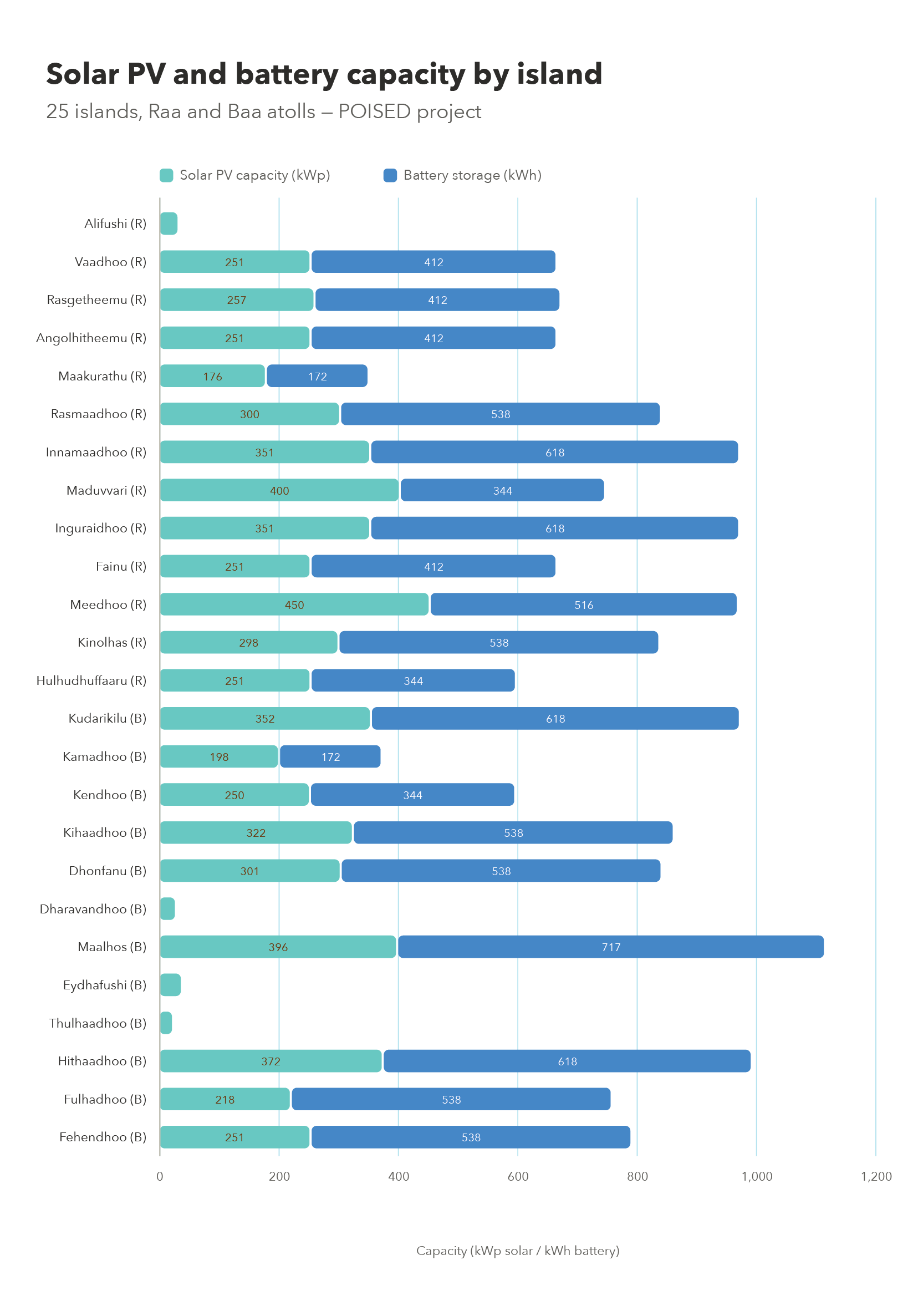
A Chart showing Solar PV and battery Capacity of the newly operationalised 25-islands in Raa and Baa Atolls under POISED Project
Data: Ministry of Climate Change, Environment and Energy

Minister of Climate Change, Environment and Energy Ali Shareef framed the moment as evidence that the pledge is being honoured. With these facilities now in operation, the Ministry estimates the country has covered roughly a quarter of the distance to the 33 percent target, with the remainder to be reached by 2028. The aim, the Ministry has said, is not only to meet the President’s target but to press beyond it in support of the wider transition.

What the New Systems Deliver

The 25 systems are expected to generate more than 10.4 gigawatt-hours of clean energy each year. That output will displace over 3 million liters of diesel annually and cut carbon dioxide emissions by roughly 8,400 metric tonnes.

The financial case is equally direct. Officials estimate savings of approximately MVR 68 million per year across the 25 islands, easing a fuel bill that has weighed heavily on the national budget. The President has noted that the Maldives spends about 10 percent of its gross domestic product on fuel each year, and that fuel imports exceeded 65 million US dollars in a single quarter of 2024. Following recent supply disruptions and the continued organic growth in fuel consumption, this expenditure is now projected to rise to approximately 13 percent of GDP.

Of the 25 islands where the solar PV systems were inaugurated, 15 can now switch off their diesel generators for between six and ten hours each day, relying instead on solar power and stored energy to maintain an uninterrupted electricity supply.

Beyond the ledger, the change is felt in the air and surroundings of island communities. Cleaner generation means fewer airborne pollutants and a quieter, more restorative environment. It also opens a sustainable path for tourism and other industries that require reliable power, without adding to the emissions that threaten the islands themselves.

Part of a Larger Effort

The 25 systems are one stage of a far broader undertaking. POISED aims to convert diesel-based microgrids on 160 islands into solar hybrid systems. To date, work has been completed on 97 islands, delivering a combined 19.8 megawatts of solar photovoltaic capacity and 20.6 megawatt-hours of battery storage now in active use.

Across the wider project, completed islands host 13.4 megawatts of peak solar capacity and 10.6 megawatt-hours of battery storage, supported by energy management systems, grid upgrades, and 27 megawatts of backup diesel generation. Work is now underway on 23 further islands, with completion expected by 2028

Taken together, the milestones point to a pledge being met not in words alone but in installed capacity, verified savings, and cleaner skies. For a country that measured its renewable share in single digits only a few years ago, the distance already covered lends credibility to the distance that remains.

 

- Advertisement -spot_img

The Government of Maldives has switched on solar hybrid power systems across 25 islands in Raa and Baa atolls, a step that officials say turns a national climate promise into measurable progress. The systems were formally inaugurated at a ceremony held on the island of Kinolhas in Raa Atoll.

The project was carried out in partnership with the Asian Development Bank and the European Investment Bank under the Preparing Outer Islands for Sustainable Energy Development, or POISED, initiative. Together, the newly commissioned systems add 6.36 megawatts of solar photovoltaic capacity and 10 megawatt-hours of battery energy storage to the national grid.

For a nation of low-lying islands that has long depended on imported diesel to keep the lights on, the shift carries weight beyond the numbers. It reduces exposure to volatile fuel prices, cuts emissions, and moves the country closer to a target the President set before the world.

A Pledge Taking Shape

At the 2023 United Nations climate conference in Dubai, President Dr. Mohamed Muizzu committed the Maldives to generating 33 percent of its electricity from renewable sources by 2028. At the time, renewable capacity stood at roughly 4 percent of demand, and the President called for at least 600 million US dollars in international support to reach the goal.

The commitment is also embedded in the country’s Nationally Determined Contribution under the Paris Agreement, giving it standing well beyond a domestic policy statement.

Progress since then has accelerated. By late 2024, the President noted that installed renewable-energy capacity had risen from 53 megawatts at the time of his announcement to 68 megawatts. With the operationalisation of the new systems across 25 islands in Raa and Baa atolls, including 6.36 megawatts of additional solar capacity, total capacity has now reached 116 megawatts—representing an increase of more than 100 percent since the President made those remarks.

A Chart showing Solar PV and battery Capacity of the newly operationalised 25-islands in Raa and Baa Atolls under POISED Project
Data: Ministry of Climate Change, Environment and Energy

Minister of Climate Change, Environment and Energy Ali Shareef framed the moment as evidence that the pledge is being honoured. With these facilities now in operation, the Ministry estimates the country has covered roughly a quarter of the distance to the 33 percent target, with the remainder to be reached by 2028. The aim, the Ministry has said, is not only to meet the President’s target but to press beyond it in support of the wider transition.

What the New Systems Deliver

The 25 systems are expected to generate more than 10.4 gigawatt-hours of clean energy each year. That output will displace over 3 million liters of diesel annually and cut carbon dioxide emissions by roughly 8,400 metric tonnes.

The financial case is equally direct. Officials estimate savings of approximately MVR 68 million per year across the 25 islands, easing a fuel bill that has weighed heavily on the national budget. The President has noted that the Maldives spends about 10 percent of its gross domestic product on fuel each year, and that fuel imports exceeded 65 million US dollars in a single quarter of 2024. Following recent supply disruptions and the continued organic growth in fuel consumption, this expenditure is now projected to rise to approximately 13 percent of GDP.

Of the 25 islands where the solar PV systems were inaugurated, 15 can now switch off their diesel generators for between six and ten hours each day, relying instead on solar power and stored energy to maintain an uninterrupted electricity supply.

Beyond the ledger, the change is felt in the air and surroundings of island communities. Cleaner generation means fewer airborne pollutants and a quieter, more restorative environment. It also opens a sustainable path for tourism and other industries that require reliable power, without adding to the emissions that threaten the islands themselves.

Part of a Larger Effort

The 25 systems are one stage of a far broader undertaking. POISED aims to convert diesel-based microgrids on 160 islands into solar hybrid systems. To date, work has been completed on 97 islands, delivering a combined 19.8 megawatts of solar photovoltaic capacity and 20.6 megawatt-hours of battery storage now in active use.

Across the wider project, completed islands host 13.4 megawatts of peak solar capacity and 10.6 megawatt-hours of battery storage, supported by energy management systems, grid upgrades, and 27 megawatts of backup diesel generation. Work is now underway on 23 further islands, with completion expected by 2028

Taken together, the milestones point to a pledge being met not in words alone but in installed capacity, verified savings, and cleaner skies. For a country that measured its renewable share in single digits only a few years ago, the distance already covered lends credibility to the distance that remains.


Advertisementspot_img

Related News