



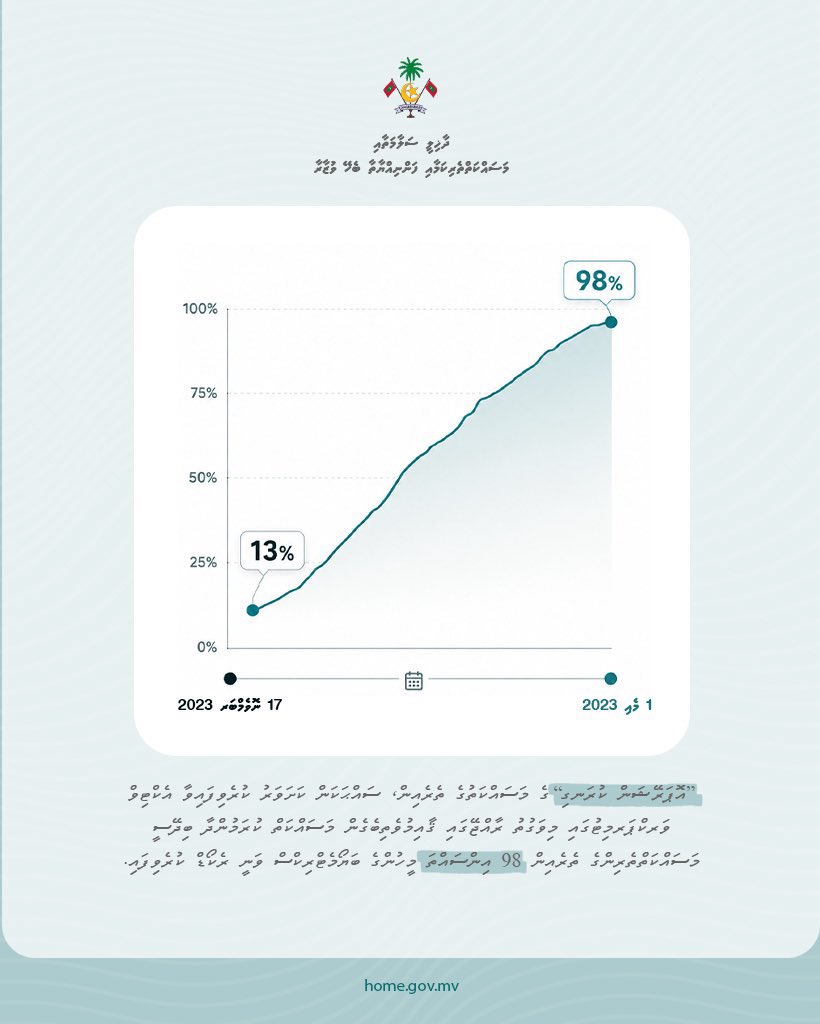
The share of migrant workers in the Maldives with complete biometric records on the government database has risen from 13 percent to 98 percent over the past two years, Minister of Homeland Security and Technology Ali Ihusan announced this week, in what the government has described as one of the most significant shifts in the country’s migration management to date.
When President Dr. Mohamed Muizzu’s administration took office on 17 November 2023, only 13 percent of migrant workers had full biometric records, comprising all ten fingerprints and facial recognition photographs, stored in government systems. According to the Minister, that figure now stands at 98 percent, giving the country a near-complete biometric identification database for its foreign workforce for the first time.
The Minister framed the earlier shortfall as more than an administrative weakness. With the vast majority of foreign workers absent from the biometric system, authorities frequently had no reliable means of verifying identities during enforcement operations when individuals lacked documents. In effect, the state often did not know with certainty who was in the country, where they were located, or whether they had entered and remained through legal channels.
Operation Kurangi and the Scale of the Drive
The expansion has been delivered largely through Operation Kurangi, a nationwide registration and regularisation programme launched by the Ministry of Homeland Security and Technology on 2 May 2024. The operation began in K. Himmafushi before expanding to the greater Malé region in January 2025 and rolling out across the atolls through local council offices and mobile registration teams.
Migrant workers form a substantial share of the Maldivian population. According to the 2022 census, expatriates account for roughly a quarter of the country’s estimated 500,000 residents, with officials acknowledging that the real figure is likely higher once previously undocumented workers are taken into account. Many enter through legal channels but fall into irregular status afterwards, often due to unpaid fees by employers, lapsed work visas, or absconder reports filed against them.
Under Operation Kurangi, the government has progressively tightened deadlines, linked biometric registration to access to the Expat Online work permit system, and warned that non-compliant workers face deportation. Earlier figures cited by the Minister indicated that the proportion of irregular migrants has fallen from around 72 percent to 38 percent since the operation began, while the share of workers meeting documentation and payment requirements has risen from roughly 29 percent to 62 percent.
What the 98% Figure Means in Practice
The Minister said the near-complete biometric database significantly strengthens national security and border control, law enforcement and immigration enforcement capabilities, the prevention of identity fraud and illegal employment, the tracking of undocumented migrants and overstayers, and broader public safety and crime prevention efforts. He added that it also bolsters international confidence in the country’s migration management systems.
The dataset is already being put to operational use. Earlier this month, the Ministry launched MI ID Checker, a facial recognition application developed by Maldives Immigration with support from the Maldives Police Service, which allows officers to identify a foreign national from a single photograph and retrieve passport, work permit, visa, employer and absconder details. Access is being extended to law enforcement agencies first, with local councils to follow.
According to the Minister, the achievement also places the Maldives among countries implementing modern biometric governance standards recognised internationally for secure migration management and identity verification.
A Two-Year Reform Effort
The biometric drive has unfolded alongside wider migration reforms. The government has publicised lists of companies owing significant sums in work permit and quota fees, recovered a substantial portion of those arrears, and amended the Employment Act to introduce penalties of up to MVR 50,000 for employers found to be negligent towards their foreign workers. Earlier in the administration’s term, President Muizzu reported that several thousand migrant workers had been deported and that public reporting tools had generated more than a thousand tips on irregular employment.
Taken together, the Minister said, Operation Kurangi and the wider reforms of the past two years demonstrate what can be achieved through political will, institutional coordination and sustained operational effort. With biometric coverage now near complete, attention is expected to turn to enforcement, employer compliance and ensuring that the protections built into the new system also work in favour of the workers it has registered.